An Overview of the Witness Protection Program
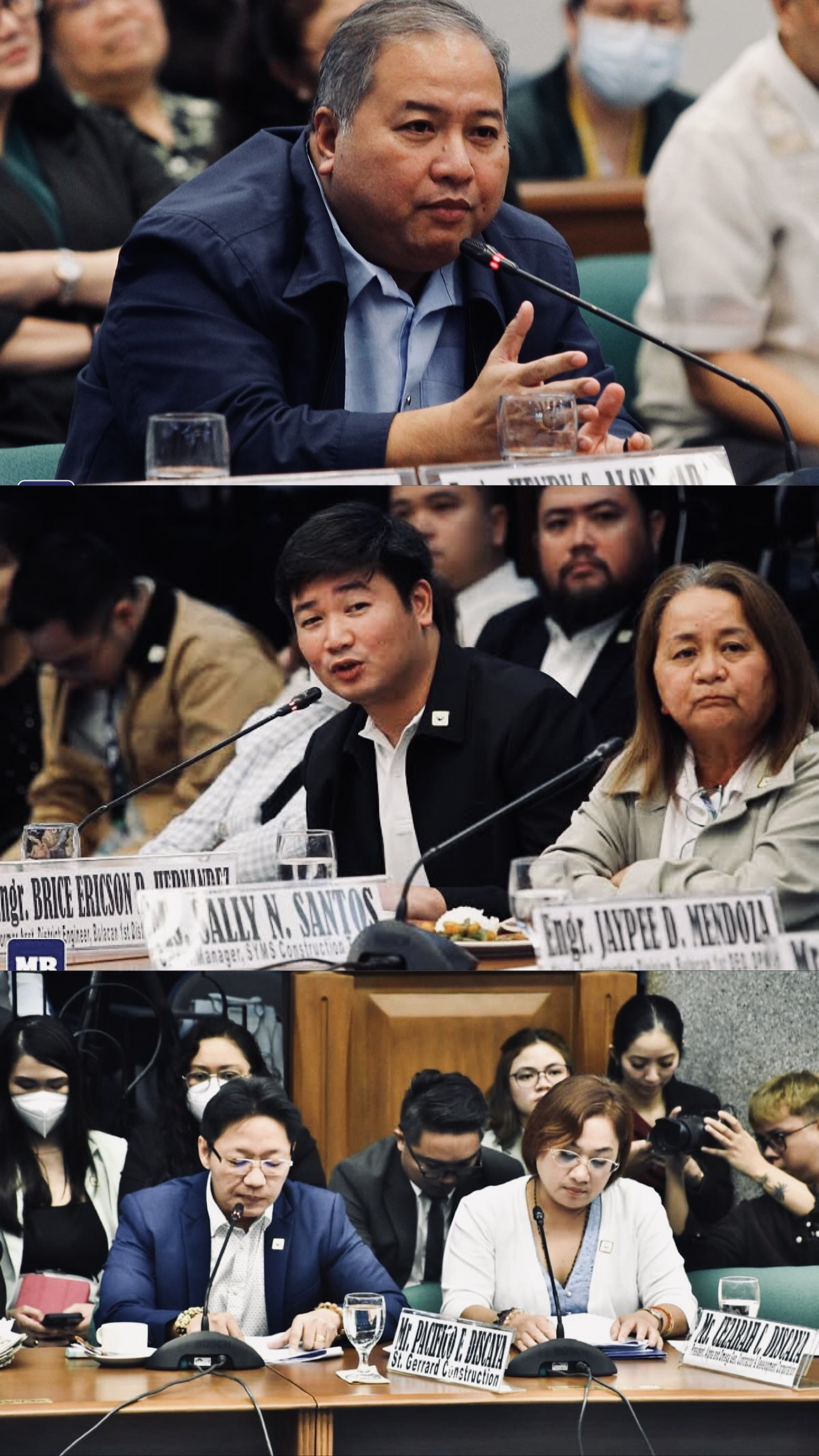
When justice depends on testimony that could place a witness’s life in danger, the law provides safeguards to ensure that truth can still be spoken. In the Philippines, this protection comes through the Witness Protection, Security and Benefit Program under Republic Act No. 6981 (1991). Below is a breakdown of its key features and practical applications.
Legal Basis
The Witness Protection, Security and Benefit Act (RA 6981) provides the framework for protecting witnesses whose testimony is crucial in criminal proceedings, particularly when threats to their safety arise. The Department of Justice (DOJ) administers the Program and may enlist the cooperation of other government agencies for its effective implementation.
Who May Be Admitted
Admission is not automatic. Under Section 3 of RA 6981, a person may be covered by the Program if:
- They have witnessed or possess vital information on the commission of a crime and are testifying (or about to testify) before a court, quasi-judicial body, or investigating authority.
-
The crime involved is a grave felony under the Revised Penal Code, or its equivalent under special laws.
-
Their testimony is material and can be substantially corroborated.
-
They or their family face threats, intimidation, or harassment because of their testimony.
-
They are not a law enforcement officer (although immediate family members of such officers may qualify).
On Becoming a State Witness
Notably, Section 10 of RA 6981 and Rule 119, Section 17 of the Rules of Court require that a state witness must “not appear to be the most guilty.”
-
“Most guilty” refers to the highest degree of culpability, not necessarily the harshest penalty (see: People v. Ocimar, G.R. No. 94555, Aug. 17, 1992; Jimenez v. People, G.R. No. 209195, Sept. 17, 2014).
-
Absolute necessity for testimony, absence of other direct evidence, and substantial corroboration are additional conditions.
Steps in Admission
-
Application to DOJ – The prospective witness submits an application, evaluated by the DOJ.
-
Evaluation & Certification – If requirements are met, the DOJ issues a certification of admission.
-
If Case is Ongoing – Where information has already been filed in court, the prosecutor may move for the discharge of an accused so they may testify as a state witness, subject to court approval.
-
Court’s Role – The trial court ensures that statutory requirements are satisfied before granting discharge.
Rights and Benefits
Once admitted, a witness enjoys:
-
Safe housing, relocation, or even change of identity.
-
Financial assistance for self and family.
-
Protection from workplace dismissal due to absences caused by witness duty.
-
Travel allowance and subsistence support.
-
Free medical care for injuries linked to testimony.
-
Burial and educational benefits for dependents in case of death.
-
Immunity from prosecution when admitted as a state witness (Sec. 12, RA 6981).
When to Invoke
The Program should be invoked when:
-
A witness’s testimony is indispensable to the prosecution of a grave crime.
-
The witness or their family faces credible threats or harassment linked to their testimony.
-
The prosecution’s evidence requires corroboration that only a witness-participant can provide.
-
An accused may be discharged to testify for the State, provided they are not the most guilty and their testimony is absolutely necessary.
Closing Note
The Witness Protection Program balances two imperatives: shielding lives and ensuring justice. It prevents the chilling effect of threats and intimidation, while also reinforcing the prosecution’s ability to present vital testimony.
At Alon & Partners Law Office, we emphasize that invoking the Program is both a legal strategy and a human safeguard—one that underscores the State’s commitment to truth and accountability.
Witness Protection, Security and Benefit Program under Republic Act No. 6981 (1991)

When justice depends on testimony that could place a witness’s life in danger, the law provides safeguards to ensure that truth can still be spoken. In the Philippines, this protection comes through the Witness Protection, Security and Benefit Program under Republic Act No. 6981 (1991). Below is a breakdown of its key features and practical applications.
Legal Basis
The Witness Protection, Security and Benefit Act (RA 6981) provides the framework for protecting witnesses whose testimony is crucial in criminal proceedings, particularly when threats to their safety arise. The Department of Justice (DOJ) administers the Program and may enlist the cooperation of other government agencies for its effective implementation.
Who May Be Admitted
Admission is not automatic. Under Section 3 of RA 6981, a person may be covered by the Program if:
- They have witnessed or possess vital information on the commission of a crime and are testifying (or about to testify) before a court, quasi-judicial body, or investigating authority.
-
The crime involved is a grave felony under the Revised Penal Code, or its equivalent under special laws.
-
Their testimony is material and can be substantially corroborated.
-
They or their family face threats, intimidation, or harassment because of their testimony.
-
They are not a law enforcement officer (although immediate family members of such officers may qualify).
On Becoming a State Witness
Notably, Section 10 of RA 6981 and Rule 119, Section 17 of the Rules of Court require that a state witness must “not appear to be the most guilty.”
-
“Most guilty” refers to the highest degree of culpability, not necessarily the harshest penalty (see: People v. Ocimar, G.R. No. 94555, Aug. 17, 1992; Jimenez v. People, G.R. No. 209195, Sept. 17, 2014).
-
Absolute necessity for testimony, absence of other direct evidence, and substantial corroboration are additional conditions.
Steps in Admission
-
Application to DOJ – The prospective witness submits an application, evaluated by the DOJ.
-
Evaluation & Certification – If requirements are met, the DOJ issues a certification of admission.
-
If Case is Ongoing – Where information has already been filed in court, the prosecutor may move for the discharge of an accused so they may testify as a state witness, subject to court approval.
-
Court’s Role – The trial court ensures that statutory requirements are satisfied before granting discharge.
Rights and Benefits
Once admitted, a witness enjoys:
-
Safe housing, relocation, or even change of identity.
-
Financial assistance for self and family.
-
Protection from workplace dismissal due to absences caused by witness duty.
-
Travel allowance and subsistence support.
-
Free medical care for injuries linked to testimony.
-
Burial and educational benefits for dependents in case of death.
-
Immunity from prosecution when admitted as a state witness (Sec. 12, RA 6981).
When to Invoke
The Program should be invoked when:
-
A witness’s testimony is indispensable to the prosecution of a grave crime.
-
The witness or their family faces credible threats or harassment linked to their testimony.
-
The prosecution’s evidence requires corroboration that only a witness-participant can provide.
-
An accused may be discharged to testify for the State, provided they are not the most guilty and their testimony is absolutely necessary.
Closing Note
The Witness Protection Program balances two imperatives: shielding lives and ensuring justice. It prevents the chilling effect of threats and intimidation, while also reinforcing the prosecution’s ability to present vital testimony.
At Alon & Partners Law Office, we emphasize that invoking the Program is both a legal strategy and a human safeguard—one that underscores the State’s commitment to truth and accountability.
The Sweetheart Defense

I. Introduction
The “sweetheart defense” is a recurring argument in Philippine rape prosecutions, where the accused claims that a romantic relationship existed with the complainant, thereby implying that the sexual act was consensual. This defense is often invoked to negate the element of force, threat, or intimidation required for a conviction of rape.
II. Legal Basis
A. Statutory Law
Under Article 266-A of the Revised Penal Code, as amended by the Anti-Rape Law of 1997 (RA 8353), rape is committed when a man has carnal knowledge of a woman under certain circumstances, including through force, threat, or intimidation, or when the offended party is under twelve years of age or is demented. The law does not recognize a romantic relationship as a defense per se; the focus remains on the presence or absence of consent.
B. Child Protection Laws
For cases involving minors, RA 11648 (2022) and related statutes provide that consent is immaterial when the victim is below the statutory age or is exploited in prostitution or subjected to sexual abuse. The law is explicit that a child cannot validly give consent to sexual acts, regardless of any alleged romantic relationship.
III. Jurisprudential Treatment
A. General Principles
The Supreme Court has consistently held that the sweetheart defense, to be credible, must be substantiated by clear and convincing evidence of a romantic relationship and, crucially, of the victim’s consent to the sexual act. Mere allegations or self-serving statements are insufficient.
“To pass muster, this Court, in People v. Olesco, requires that the defense must prove with compelling evidence the following elements: first, that the accused and the victim were lovers; and second, that she consented to the alleged sexual relations. As indicia of the purported relationship between the accused and the victim, evidence such as letters, documents, photographs, ‘or any concrete proof of a romantic nature’ must be proffered.”
— Toraldeyhernandez v. People of the Philippines (2025)
Even if a romantic relationship is established, it does not automatically negate the crime of rape. The Supreme Court has repeatedly emphasized:
“Love is not a license for carnal intercourse through force or intimidation. Even granting that appellant and complainant were really sweethearts, that fact alone would not negate the commission of rape. A sweetheart cannot be forced to have sex against her will.”
— Toraldeyhernandez v. People of the Philippines (2025)
B. Application in Recent Cases
In People v. Sernadilla (2022), the Court reiterated that the sweetheart theory is not credible when based solely on the accused’s testimony. Even if a romantic relationship is proven, it does not equate to consent for every sexual act.
Similarly, in People v. Quinto (2020), the Supreme Court rejected the sweetheart defense due to lack of corroborative evidence and stressed that the existence of a romantic relationship does not preclude the commission of rape.
C. Special Rule for Minors
For victims below the statutory age or those exploited in prostitution or sexual abuse, the sweetheart defense is categorically unavailing. As held in People v. Udang, Sr. (2018):
“For purposes of sexual intercourse and lascivious conduct in child abuse cases under RA 7610, the sweetheart defense is unacceptable. A child exploited in prostitution or subjected to other sexual abuse cannot validly give consent to sexual intercourse with another person. The language of the law is clear: it seeks to punish those who commit the act of sexual intercourse or lascivious conduct with a child exploited in prostitution or subjected to sexual abuse. Unlike rape, therefore, consent is immaterial in cases involving violation of Section 5, Article III of RA 7610. The mere act of having sexual intercourse or committing lascivious conduct with a child who is exploited in prostitution or subjected to sexual abuse constitutes the offense. It is a malum prohibitum, an evil that is proscribed.”
— People v. Udang, Sr. (2018)
IV. Summary Table: Sweetheart Defense in Rape Cases
SCENARIO IS SWEETHEART DEFENSE VALID? KEY REQUIREMENT/RULE AUTHORITY
Adult victim, alleged romantic relation Possible, but rarely upheld Must prove both relationship and actual consent to the specific act J2, J1, J6
Minor victim (statutory rape/abuse) Not valid Consent is immaterial; law presumes lack of capacity to consent L1, J5
Child exploited in prostitution/abuse Not valid Consent is immaterial; mere act constitutes the offense L1, J5
V. Conclusion
The sweetheart defense is a much-abused and generally disfavored argument in Philippine rape cases. The Supreme Court requires compelling evidence of both a romantic relationship and actual consent to the sexual act. Even then, consent is immaterial in cases involving minors or children exploited in prostitution or sexual abuse. The consistent judicial approach is to prioritize the protection of victims, especially minors, and to scrutinize the sweetheart defense with utmost caution.
By Alon & Partners Law Office

Self-defense is a well-established justifying circumstance under Philippine criminal law. It is enshrined in Article 11 of the Revised Penal Code, which provides that a person is not criminally liable for an act done in defense of oneself, provided certain requisites are met. This doctrine is rooted in the fundamental right to life and the principle that no one should be penalized for protecting themselves from unlawful aggression.
Essential Elements of Self-Defense
The Supreme Court has consistently held that for self-defense to be appreciated as a justifying circumstance, the following elements must be proven by clear and convincing evidence:
Unlawful Aggression – There must be an actual or imminent threat to the life or limb of the person invoking self-defense.
Reasonable Necessity of the Means Employed – The means used to prevent or repel the aggression must be commensurate to the threat faced.
Lack of Sufficient Provocation – The person defending themselves must not have provoked the aggressor, or if there was provocation, it was not the proximate and immediate cause of the aggression.
These elements are consistently reiterated in recent jurisprudence. For instance, in People v. Malate (2023), the Supreme Court stated:
“In self-defense, the following elements must concur: (1) unlawful aggression on the part of the victim, (2) reasonable necessity of the means employed to prevent or repel such aggression, and (3) lack of sufficient provocation on the part of the person resorting to self-defense.”
— People v. Malate (2023)
Burden of Proof
When an accused admits to the act but claims self-defense, the burden of proof shifts to them. They must establish all the elements of self-defense by clear, satisfactory, and convincing evidence. The prosecution is relieved from proving guilt beyond reasonable doubt only as to the fact of the act, but not as to the absence of justification. As explained in People v. Lopez, Jr. (2018):
“If the accused, however, admits killing the victim, but pleads self-defense, it now becomes incumbent upon him to prove by clear, satisfactory and convincing evidence all the elements of said justifying circumstance in order to escape liability.”
— People v. Lopez, Jr. (2018)
The Primacy of Unlawful Aggression
Unlawful aggression is the most crucial element. Without it, self-defense cannot be appreciated, regardless of the presence of the other elements. The Supreme Court in People v. Panerio, et al. (2018) emphasized:
“Most important among the requisites of self-defense is unlawful aggression which is the condition sine qua non for upholding self-defense as justifying circumstance. Unless the victim commits unlawful aggression against the accused, self-defense, whether complete or incomplete, cannot be appreciated…”
— People v. Panerio, et al. (2018)
Recent Jurisprudence
The Supreme Court continues to apply and clarify the doctrine of self-defense in recent cases. In People v. Malate (2023), the Court reiterated that the accused must present competent evidence to support the claim of self-defense, and that mere allegations, if uncorroborated, are insufficient. Similarly, in People v. Duavis (2011), the Court held that absent the essential element of unlawful aggression, the claim of self-defense must fail People v. Duavis (2011).
Self-Defense and the Use of Firearms
The right to self-defense may include the use of firearms, but this is subject to strict regulation. The Supreme Court in Acosta v. Ochoa (2019) clarified that the right to possess and use firearms for self-defense is not absolute and is subject to the State’s police power:
“The right to self-defense, if it is to be done through the use of firearms, is granted to ‘qualified citizens’: those who have satisfied the qualifications for obtaining a license to own and possess firearms under Republic Act No. 10591. Therefore, even with the new law, the exercise of the right to use a firearm, even for self-defense, is still subject to State regulation.”
— Acosta v. Ochoa (2019)
Conclusion
The doctrine of self-defense remains a cornerstone of Philippine criminal law, balancing the right to protect oneself with the need to prevent abuse of this justification. The Supreme Court’s latest pronouncements underscore the strict requirements for its successful invocation, particularly the necessity of proving unlawful aggression and the proportionality of the means employed.
Overview of the One-Year Bar Rule
The one-year bar rule in Philippine impeachment proceedings is a constitutional safeguard designed to prevent the harassment of impeachable officials and to ensure the efficient functioning of the legislative branch. This rule is expressly provided in Section 3(5), Article XI of the 1987 Constitution (1987):
“No impeachment proceedings shall be initiated against the same official more than once within a period of one year.” — 1987 Constitution, Art. XI, Sec. 3(5)
This provision means that once an impeachment proceeding has been initiated against an official, no other impeachment proceeding can be commenced against the same official within the next twelve months.
Rationale Behind the Rule
The Supreme Court has explained that the one-year bar serves two primary purposes:
To protect high-ranking officials from undue or too frequent harassment through repeated impeachment complaints.
To allow the legislature to focus on its principal task of lawmaking, as impeachment proceedings are time-consuming and could otherwise paralyze legislative work.
As articulated in Gutierrez v. House of Representatives Committee on Justice (2011):
“The purpose of the one-year bar is two-fold: ‘to prevent undue or too frequent harassment; and to allow the legislature to do its principal task [of] legislation.’ … The impeachable officer should defend himself in only one impeachment proceeding, so that he will not be precluded from performing his official functions and duties. Similarly, Congress should run only one impeachment proceeding so as not to leave it with little time to attend to its main work of law-making.” — Gutierrez v. House of Representatives Committee on Justice (2011)
When Is an Impeachment Proceeding “Initiated”?
The Supreme Court, in Francisco, Jr. v. House of Representatives (2003), clarified that an impeachment proceeding is deemed “initiated” upon the referral of a verified complaint to the House Committee on Justice. This interpretation prevents the circumvention of the one-year bar by the mere filing of multiple complaints without formal referral.
This doctrine was reaffirmed in Gutierrez v. House of Representatives Committee on Justice (2011), where the Court emphasized that the bar applies to the initiation of proceedings, not merely the filing of complaints.
Application and Enforcement
The Supreme Court has consistently enforced the one-year bar rule to prevent successive impeachment complaints within a year. In Francisco, Jr. v. House of Representatives (2003), the Court declared a second impeachment complaint against Chief Justice Davide as unconstitutional because it was initiated within one year from the first.
Summary Table: Key Doctrines on the One-Year Bar Rule
PRINCIPLE/DOCTRINE SOURCE
One-year bar on impeachment 1987 Constitution, Art. XI, Sec. 3(5)
“Initiation” means referral to committee Francisco, Jr. v. House of Representatives (2003); Gutierrez (2011)
Rationale: prevent harassment, allow legislation Gutierrez (2011)
Conclusion
The one-year bar rule is a critical constitutional mechanism that balances the need for accountability of high officials with the need to protect them from political harassment and to ensure legislative efficiency. The Supreme Court’s consistent interpretation—most notably in Francisco, Jr. v. House of Representatives (2003) and Gutierrez v. House of Representatives Committee on Justice (2011)—anchors the rule’s application in both letter and spirit.
Witness Protection, Security and Benefit Program under Republic Act No. 6981 (1991)
When justice depends on testimony that could place a witness’s life in danger, the law provides safeguards to ensure that truth can still be spoken. In the Philippines, this protection comes through the Witness Protection, Security and Benefit Program under Republic Act No. 6981 (1991). Below is a breakdown of its key features and practical applications.
Legal Basis
The Witness Protection, Security and Benefit Act (RA 6981) provides the framework for protecting witnesses whose testimony is crucial in criminal proceedings, particularly when threats to their safety arise. The Department of Justice (DOJ) administers the Program and may enlist the cooperation of other government agencies for its effective implementation.
Who May Be Admitted
Admission is not automatic. Under Section 3 of RA 6981, a person may be covered by the Program if:
- They have witnessed or possess vital information on the commission of a crime and are testifying (or about to testify) before a court, quasi-judicial body, or investigating authority.
-
The crime involved is a grave felony under the Revised Penal Code, or its equivalent under special laws.
-
Their testimony is material and can be substantially corroborated.
-
They or their family face threats, intimidation, or harassment because of their testimony.
-
They are not a law enforcement officer (although immediate family members of such officers may qualify).
On Becoming a State Witness
Notably, Section 10 of RA 6981 and Rule 119, Section 17 of the Rules of Court require that a state witness must “not appear to be the most guilty.”
-
“Most guilty” refers to the highest degree of culpability, not necessarily the harshest penalty (see: People v. Ocimar, G.R. No. 94555, Aug. 17, 1992; Jimenez v. People, G.R. No. 209195, Sept. 17, 2014).
-
Absolute necessity for testimony, absence of other direct evidence, and substantial corroboration are additional conditions.
Steps in Admission
-
Application to DOJ – The prospective witness submits an application, evaluated by the DOJ.
-
Evaluation & Certification – If requirements are met, the DOJ issues a certification of admission.
-
If Case is Ongoing – Where information has already been filed in court, the prosecutor may move for the discharge of an accused so they may testify as a state witness, subject to court approval.
-
Court’s Role – The trial court ensures that statutory requirements are satisfied before granting discharge.
Rights and Benefits
Once admitted, a witness enjoys:
-
Safe housing, relocation, or even change of identity.
-
Financial assistance for self and family.
-
Protection from workplace dismissal due to absences caused by witness duty.
-
Travel allowance and subsistence support.
-
Free medical care for injuries linked to testimony.
-
Burial and educational benefits for dependents in case of death.
-
Immunity from prosecution when admitted as a state witness (Sec. 12, RA 6981).
When to Invoke
The Program should be invoked when:
-
A witness’s testimony is indispensable to the prosecution of a grave crime.
-
The witness or their family faces credible threats or harassment linked to their testimony.
-
The prosecution’s evidence requires corroboration that only a witness-participant can provide.
-
An accused may be discharged to testify for the State, provided they are not the most guilty and their testimony is absolutely necessary.
Closing Note
The Witness Protection Program balances two imperatives: shielding lives and ensuring justice. It prevents the chilling effect of threats and intimidation, while also reinforcing the prosecution’s ability to present vital testimony.
At Alon & Partners Law Office, we emphasize that invoking the Program is both a legal strategy and a human safeguard—one that underscores the State’s commitment to truth and accountability.
An Overview of the Witness Protection Program
When justice depends on testimony that could place a witness’s life in danger, the law provides safeguards to ensure that truth can still be spoken. In the Philippines, this protection comes through the Witness Protection, Security and Benefit Program under Republic Act No. 6981 (1991). Below is a breakdown of its key features and practical applications.
Legal Basis
The Witness Protection, Security and Benefit Act (RA 6981) provides the framework for protecting witnesses whose testimony is crucial in criminal proceedings, particularly when threats to their safety arise. The Department of Justice (DOJ) administers the Program and may enlist the cooperation of other government agencies for its effective implementation.
Who May Be Admitted
Admission is not automatic. Under Section 3 of RA 6981, a person may be covered by the Program if:
- They have witnessed or possess vital information on the commission of a crime and are testifying (or about to testify) before a court, quasi-judicial body, or investigating authority.
-
The crime involved is a grave felony under the Revised Penal Code, or its equivalent under special laws.
-
Their testimony is material and can be substantially corroborated.
-
They or their family face threats, intimidation, or harassment because of their testimony.
-
They are not a law enforcement officer (although immediate family members of such officers may qualify).
On Becoming a State Witness
Notably, Section 10 of RA 6981 and Rule 119, Section 17 of the Rules of Court require that a state witness must “not appear to be the most guilty.”
-
“Most guilty” refers to the highest degree of culpability, not necessarily the harshest penalty (see: People v. Ocimar, G.R. No. 94555, Aug. 17, 1992; Jimenez v. People, G.R. No. 209195, Sept. 17, 2014).
-
Absolute necessity for testimony, absence of other direct evidence, and substantial corroboration are additional conditions.
Steps in Admission
-
Application to DOJ – The prospective witness submits an application, evaluated by the DOJ.
-
Evaluation & Certification – If requirements are met, the DOJ issues a certification of admission.
-
If Case is Ongoing – Where information has already been filed in court, the prosecutor may move for the discharge of an accused so they may testify as a state witness, subject to court approval.
-
Court’s Role – The trial court ensures that statutory requirements are satisfied before granting discharge.
Rights and Benefits
Once admitted, a witness enjoys:
-
Safe housing, relocation, or even change of identity.
-
Financial assistance for self and family.
-
Protection from workplace dismissal due to absences caused by witness duty.
-
Travel allowance and subsistence support.
-
Free medical care for injuries linked to testimony.
-
Burial and educational benefits for dependents in case of death.
-
Immunity from prosecution when admitted as a state witness (Sec. 12, RA 6981).
When to Invoke
The Program should be invoked when:
-
A witness’s testimony is indispensable to the prosecution of a grave crime.
-
The witness or their family faces credible threats or harassment linked to their testimony.
-
The prosecution’s evidence requires corroboration that only a witness-participant can provide.
-
An accused may be discharged to testify for the State, provided they are not the most guilty and their testimony is absolutely necessary.
Closing Note
The Witness Protection Program balances two imperatives: shielding lives and ensuring justice. It prevents the chilling effect of threats and intimidation, while also reinforcing the prosecution’s ability to present vital testimony.
At Alon & Partners Law Office, we emphasize that invoking the Program is both a legal strategy and a human safeguard—one that underscores the State’s commitment to truth and accountability.
Witness Protection, Security and Benefit Program under Republic Act No. 6981 (1991)
When justice depends on testimony that could place a witness’s life in danger, the law provides safeguards to ensure that truth can still be spoken. In the Philippines, this protection comes through the Witness Protection, Security and Benefit Program under Republic Act No. 6981 (1991). Below is a breakdown of its key features and practical applications.
Legal Basis
The Witness Protection, Security and Benefit Act (RA 6981) provides the framework for protecting witnesses whose testimony is crucial in criminal proceedings, particularly when threats to their safety arise. The Department of Justice (DOJ) administers the Program and may enlist the cooperation of other government agencies for its effective implementation.
Who May Be Admitted
Admission is not automatic. Under Section 3 of RA 6981, a person may be covered by the Program if:
- They have witnessed or possess vital information on the commission of a crime and are testifying (or about to testify) before a court, quasi-judicial body, or investigating authority.
-
The crime involved is a grave felony under the Revised Penal Code, or its equivalent under special laws.
-
Their testimony is material and can be substantially corroborated.
-
They or their family face threats, intimidation, or harassment because of their testimony.
-
They are not a law enforcement officer (although immediate family members of such officers may qualify).
On Becoming a State Witness
Notably, Section 10 of RA 6981 and Rule 119, Section 17 of the Rules of Court require that a state witness must “not appear to be the most guilty.”
-
“Most guilty” refers to the highest degree of culpability, not necessarily the harshest penalty (see: People v. Ocimar, G.R. No. 94555, Aug. 17, 1992; Jimenez v. People, G.R. No. 209195, Sept. 17, 2014).
-
Absolute necessity for testimony, absence of other direct evidence, and substantial corroboration are additional conditions.
Steps in Admission
-
Application to DOJ – The prospective witness submits an application, evaluated by the DOJ.
-
Evaluation & Certification – If requirements are met, the DOJ issues a certification of admission.
-
If Case is Ongoing – Where information has already been filed in court, the prosecutor may move for the discharge of an accused so they may testify as a state witness, subject to court approval.
-
Court’s Role – The trial court ensures that statutory requirements are satisfied before granting discharge.
Rights and Benefits
Once admitted, a witness enjoys:
-
Safe housing, relocation, or even change of identity.
-
Financial assistance for self and family.
-
Protection from workplace dismissal due to absences caused by witness duty.
-
Travel allowance and subsistence support.
-
Free medical care for injuries linked to testimony.
-
Burial and educational benefits for dependents in case of death.
-
Immunity from prosecution when admitted as a state witness (Sec. 12, RA 6981).
When to Invoke
The Program should be invoked when:
-
A witness’s testimony is indispensable to the prosecution of a grave crime.
-
The witness or their family faces credible threats or harassment linked to their testimony.
-
The prosecution’s evidence requires corroboration that only a witness-participant can provide.
-
An accused may be discharged to testify for the State, provided they are not the most guilty and their testimony is absolutely necessary.
Closing Note
The Witness Protection Program balances two imperatives: shielding lives and ensuring justice. It prevents the chilling effect of threats and intimidation, while also reinforcing the prosecution’s ability to present vital testimony.
At Alon & Partners Law Office, we emphasize that invoking the Program is both a legal strategy and a human safeguard—one that underscores the State’s commitment to truth and accountability.
Lanao del Norte
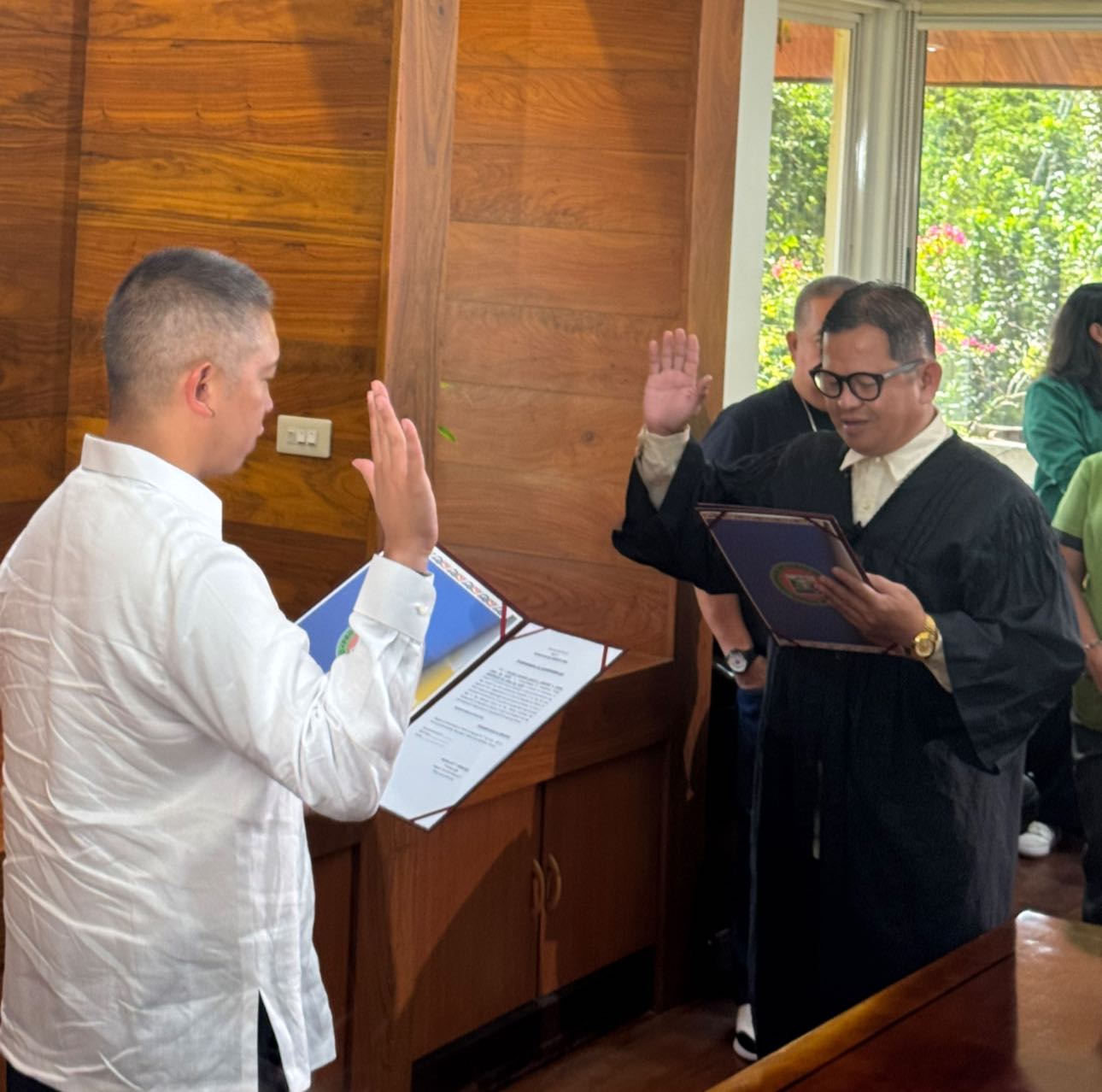
Alon & Partners Law extends its warmest congratulations to the newly inaugurated Governor of Lanao del Norte, former 1st District Congressman Mohamad Khalid Q. Dimaporo, as he officially begins his first day in office—timely coinciding with the week-long celebration of Araw ng Lanao del Norte.
Gov. Khalid first assumed office as governor of Lanao del Norte from 2007 to 2016, before being elected in 2016 as Representative of the province’s 1st District—he has since been reelected in 2019 and 2022, and currently chairs the House Committee on Muslim Affairs as well as vice‑chairs the Committee on West Philippine Sea.
Congratulations, from your UNLAD Lawyers in Alon & Partners Law Office!
COMELEC
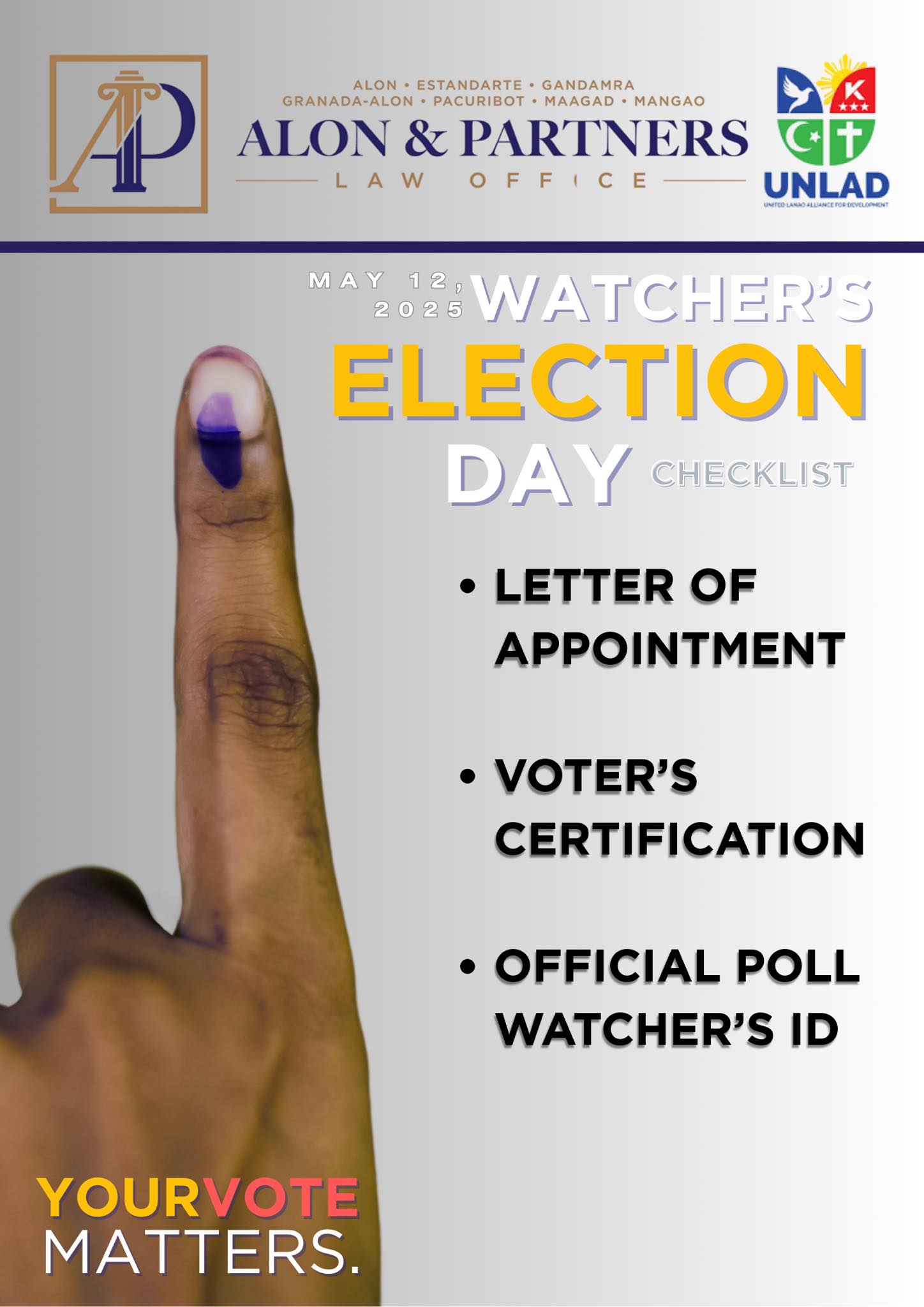
As we safeguard the integrity of the elections this May 12, 2025, make sure to bring the following before entering the polling precincts:
1. Letter of Appointment – issued by the political party, candidate, or party-list organization they represent, signed by the authorized representative and submitted to the Electoral Board.
2. Poll Watcher’s Identification Card – this is usually issued by the party or candidate, and must be worn visibly.
3. Voter’s Certification or ID – proof that the poll watcher is a registered voter, which may be required for verification purposes.
These are required under COMELEC Resolution No. 10773 (or its updated version for the 2025 elections) to ensure that only duly authorized individuals can act as watchers and observe the electoral process
An Overview of the Witness Protection Program
When justice depends on testimony that could place a witness’s life in danger, the law provides safeguards to ensure that truth can still be spoken. In the Philippines, this protection comes through the Witness Protection, Security and Benefit Program under Republic Act No. 6981 (1991). Below is a breakdown of its key features and practical applications.
Legal Basis
The Witness Protection, Security and Benefit Act (RA 6981) provides the framework for protecting witnesses whose testimony is crucial in criminal proceedings, particularly when threats to their safety arise. The Department of Justice (DOJ) administers the Program and may enlist the cooperation of other government agencies for its effective implementation.
Who May Be Admitted
Admission is not automatic. Under Section 3 of RA 6981, a person may be covered by the Program if:
- They have witnessed or possess vital information on the commission of a crime and are testifying (or about to testify) before a court, quasi-judicial body, or investigating authority.
-
The crime involved is a grave felony under the Revised Penal Code, or its equivalent under special laws.
-
Their testimony is material and can be substantially corroborated.
-
They or their family face threats, intimidation, or harassment because of their testimony.
-
They are not a law enforcement officer (although immediate family members of such officers may qualify).
On Becoming a State Witness
Notably, Section 10 of RA 6981 and Rule 119, Section 17 of the Rules of Court require that a state witness must “not appear to be the most guilty.”
-
“Most guilty” refers to the highest degree of culpability, not necessarily the harshest penalty (see: People v. Ocimar, G.R. No. 94555, Aug. 17, 1992; Jimenez v. People, G.R. No. 209195, Sept. 17, 2014).
-
Absolute necessity for testimony, absence of other direct evidence, and substantial corroboration are additional conditions.
Steps in Admission
-
Application to DOJ – The prospective witness submits an application, evaluated by the DOJ.
-
Evaluation & Certification – If requirements are met, the DOJ issues a certification of admission.
-
If Case is Ongoing – Where information has already been filed in court, the prosecutor may move for the discharge of an accused so they may testify as a state witness, subject to court approval.
-
Court’s Role – The trial court ensures that statutory requirements are satisfied before granting discharge.
Rights and Benefits
Once admitted, a witness enjoys:
-
Safe housing, relocation, or even change of identity.
-
Financial assistance for self and family.
-
Protection from workplace dismissal due to absences caused by witness duty.
-
Travel allowance and subsistence support.
-
Free medical care for injuries linked to testimony.
-
Burial and educational benefits for dependents in case of death.
-
Immunity from prosecution when admitted as a state witness (Sec. 12, RA 6981).
When to Invoke
The Program should be invoked when:
-
A witness’s testimony is indispensable to the prosecution of a grave crime.
-
The witness or their family faces credible threats or harassment linked to their testimony.
-
The prosecution’s evidence requires corroboration that only a witness-participant can provide.
-
An accused may be discharged to testify for the State, provided they are not the most guilty and their testimony is absolutely necessary.
Closing Note
The Witness Protection Program balances two imperatives: shielding lives and ensuring justice. It prevents the chilling effect of threats and intimidation, while also reinforcing the prosecution’s ability to present vital testimony.
At Alon & Partners Law Office, we emphasize that invoking the Program is both a legal strategy and a human safeguard—one that underscores the State’s commitment to truth and accountability.
Witness Protection, Security and Benefit Program under Republic Act No. 6981 (1991)
When justice depends on testimony that could place a witness’s life in danger, the law provides safeguards to ensure that truth can still be spoken. In the Philippines, this protection comes through the Witness Protection, Security and Benefit Program under Republic Act No. 6981 (1991). Below is a breakdown of its key features and practical applications.
Legal Basis
The Witness Protection, Security and Benefit Act (RA 6981) provides the framework for protecting witnesses whose testimony is crucial in criminal proceedings, particularly when threats to their safety arise. The Department of Justice (DOJ) administers the Program and may enlist the cooperation of other government agencies for its effective implementation.
Who May Be Admitted
Admission is not automatic. Under Section 3 of RA 6981, a person may be covered by the Program if:
- They have witnessed or possess vital information on the commission of a crime and are testifying (or about to testify) before a court, quasi-judicial body, or investigating authority.
-
The crime involved is a grave felony under the Revised Penal Code, or its equivalent under special laws.
-
Their testimony is material and can be substantially corroborated.
-
They or their family face threats, intimidation, or harassment because of their testimony.
-
They are not a law enforcement officer (although immediate family members of such officers may qualify).
On Becoming a State Witness
Notably, Section 10 of RA 6981 and Rule 119, Section 17 of the Rules of Court require that a state witness must “not appear to be the most guilty.”
-
“Most guilty” refers to the highest degree of culpability, not necessarily the harshest penalty (see: People v. Ocimar, G.R. No. 94555, Aug. 17, 1992; Jimenez v. People, G.R. No. 209195, Sept. 17, 2014).
-
Absolute necessity for testimony, absence of other direct evidence, and substantial corroboration are additional conditions.
Steps in Admission
-
Application to DOJ – The prospective witness submits an application, evaluated by the DOJ.
-
Evaluation & Certification – If requirements are met, the DOJ issues a certification of admission.
-
If Case is Ongoing – Where information has already been filed in court, the prosecutor may move for the discharge of an accused so they may testify as a state witness, subject to court approval.
-
Court’s Role – The trial court ensures that statutory requirements are satisfied before granting discharge.
Rights and Benefits
Once admitted, a witness enjoys:
-
Safe housing, relocation, or even change of identity.
-
Financial assistance for self and family.
-
Protection from workplace dismissal due to absences caused by witness duty.
-
Travel allowance and subsistence support.
-
Free medical care for injuries linked to testimony.
-
Burial and educational benefits for dependents in case of death.
-
Immunity from prosecution when admitted as a state witness (Sec. 12, RA 6981).
When to Invoke
The Program should be invoked when:
-
A witness’s testimony is indispensable to the prosecution of a grave crime.
-
The witness or their family faces credible threats or harassment linked to their testimony.
-
The prosecution’s evidence requires corroboration that only a witness-participant can provide.
-
An accused may be discharged to testify for the State, provided they are not the most guilty and their testimony is absolutely necessary.
Closing Note
The Witness Protection Program balances two imperatives: shielding lives and ensuring justice. It prevents the chilling effect of threats and intimidation, while also reinforcing the prosecution’s ability to present vital testimony.
At Alon & Partners Law Office, we emphasize that invoking the Program is both a legal strategy and a human safeguard—one that underscores the State’s commitment to truth and accountability.
Witness Protection, Security and Benefit Program under Republic Act No. 6981 (1991)
When justice depends on testimony that could place a witness’s life in danger, the law provides safeguards to ensure that truth can still be spoken. In the Philippines, this protection comes through the Witness Protection, Security and Benefit Program under Republic Act No. 6981 (1991). Below is a breakdown of its key features and practical applications.
Legal Basis
The Witness Protection, Security and Benefit Act (RA 6981) provides the framework for protecting witnesses whose testimony is crucial in criminal proceedings, particularly when threats to their safety arise. The Department of Justice (DOJ) administers the Program and may enlist the cooperation of other government agencies for its effective implementation.
Who May Be Admitted
Admission is not automatic. Under Section 3 of RA 6981, a person may be covered by the Program if:
- They have witnessed or possess vital information on the commission of a crime and are testifying (or about to testify) before a court, quasi-judicial body, or investigating authority.
-
The crime involved is a grave felony under the Revised Penal Code, or its equivalent under special laws.
-
Their testimony is material and can be substantially corroborated.
-
They or their family face threats, intimidation, or harassment because of their testimony.
-
They are not a law enforcement officer (although immediate family members of such officers may qualify).
On Becoming a State Witness
Notably, Section 10 of RA 6981 and Rule 119, Section 17 of the Rules of Court require that a state witness must “not appear to be the most guilty.”
-
“Most guilty” refers to the highest degree of culpability, not necessarily the harshest penalty (see: People v. Ocimar, G.R. No. 94555, Aug. 17, 1992; Jimenez v. People, G.R. No. 209195, Sept. 17, 2014).
-
Absolute necessity for testimony, absence of other direct evidence, and substantial corroboration are additional conditions.
Steps in Admission
-
Application to DOJ – The prospective witness submits an application, evaluated by the DOJ.
-
Evaluation & Certification – If requirements are met, the DOJ issues a certification of admission.
-
If Case is Ongoing – Where information has already been filed in court, the prosecutor may move for the discharge of an accused so they may testify as a state witness, subject to court approval.
-
Court’s Role – The trial court ensures that statutory requirements are satisfied before granting discharge.
Rights and Benefits
Once admitted, a witness enjoys:
-
Safe housing, relocation, or even change of identity.
-
Financial assistance for self and family.
-
Protection from workplace dismissal due to absences caused by witness duty.
-
Travel allowance and subsistence support.
-
Free medical care for injuries linked to testimony.
-
Burial and educational benefits for dependents in case of death.
-
Immunity from prosecution when admitted as a state witness (Sec. 12, RA 6981).
When to Invoke
The Program should be invoked when:
-
A witness’s testimony is indispensable to the prosecution of a grave crime.
-
The witness or their family faces credible threats or harassment linked to their testimony.
-
The prosecution’s evidence requires corroboration that only a witness-participant can provide.
-
An accused may be discharged to testify for the State, provided they are not the most guilty and their testimony is absolutely necessary.
Closing Note
The Witness Protection Program balances two imperatives: shielding lives and ensuring justice. It prevents the chilling effect of threats and intimidation, while also reinforcing the prosecution’s ability to present vital testimony.
At Alon & Partners Law Office, we emphasize that invoking the Program is both a legal strategy and a human safeguard—one that underscores the State’s commitment to truth and accountability.
Hitting pause on the grind.

The team at Alon & Partners Law Office recently traded their legal briefs for boat shoes, as they embarked on an invigorating team-building retreat. The firm’s employees enjoyed a refreshing escape, fostering camaraderie and strengthening their bonds outside the courtroom.
The adventure included a delightful boat trip, where the team was captured enjoying the open waters and vibrant company. Photos show the group in high spirits, some raising celebratory drinks, against the picturesque backdrop of the sea and sky. Another image captures the team disembarking from a boat at what appears to be a bustling pier, ready for more activities.
The retreat provided a perfect opportunity for the Alon & Partners Law Office team to relax, connect, and reinforce their collaborative spirit, ensuring they return to their legal practice with renewed energy and a stronger sense of unity.